


CQC inspection readiness: the practice manager's checklist
An evidence checklist for dental practices in England: what to check, who owns it and how to follow up gaps.

Published by Dr Sim Raiyat
Clinical Director, Dentorb — Private General Dentist
CQC inspection readiness means being able to explain how your dental practice works and show that important processes are followed. For a practice manager, a useful evidence check asks three questions: can we find the record, does it match real work, and who owns the next action?
This checklist is for dental services in England. It is an organising aid, not an official Care Quality Commission (CQC) checklist or a complete statement of your obligations. Use the requirements that apply to your service and any specific CQC request. If you are organising a visit, start with preparing for a CQC inspection; use this page to test the evidence itself.
Key takeaways
- Check the result and any follow-up, rather than relying on a completed task label.
- A recorded gap is still a gap. Assess the risk and take the necessary action; logging it does not make an unsafe situation acceptable.
- Give each action an owner and a review point. Keep required checks on their applicable schedules.
CQC's good-governance guidance requires effective systems for assessing quality, managing risks, maintaining records and improvement. The workflow below is our practical way to organise an evidence check; it is not a CQC scoring system.
A checklist you can assign today
| Area | What to check | Follow up if… |
|---|---|---|
| Recruitment and responsibilities | Records support the person's role and the recruitment checks that apply | A required check, decision or explanation is missing |
| Registration | Current professional registration has been checked where required | The recorded status cannot be confirmed |
| Training | Relevant learning and evidence can be traced to the person's work | A course is only booked, evidence is unclear or support is still needed |
| Policies | Staff can locate the current procedure and explain the task | Two versions remain in use or a safety question is unanswered |
| Safety checks and equipment | Records show the result and any response needed | A failed check is marked “done” without an outcome |
| Audits | Findings lead to decisions, actions and a later check | The file contains only a blank form or an unexplained score |
| Complaints and feedback | The response and any improvement can be followed | An unresolved concern has lost its owner |
| Leadership | Decisions have owners, deadlines and follow-up | Deadlines repeatedly move without a recorded reason |
Assign a day-to-day owner to each area, while keeping the provider's oversight clear. Record where evidence lives and what needs attention. Avoid making a second copy of every record simply to fill an inspection folder: copies can become inconsistent.
Give each check a clear outcome
One tick box labelled “compliant” hides too much. These suggested labels help a colleague understand what you found.
| Outcome | What it means | Next step |
|---|---|---|
| Evidence checked | The relevant record was found and checked for this question | Record who checked it, when and what they concluded |
| Evidence missing or unclear | You cannot establish the answer from the available information | Investigate; do not assume the task happened |
| Action needed | The finding requires a response | Assess urgency, name an owner and record the next action |
| Not applicable | The check does not apply to this service or role | Record the reason and who confirmed it |
“Evidence checked” does not mean that the whole practice is compliant. It means you checked a particular question. A safety concern can require immediate escalation even while its evidence is being investigated.
Do not backdate a missing record or present an unverified reconstruction as evidence that a check happened. Record what you can establish, when you established it and what remains uncertain.
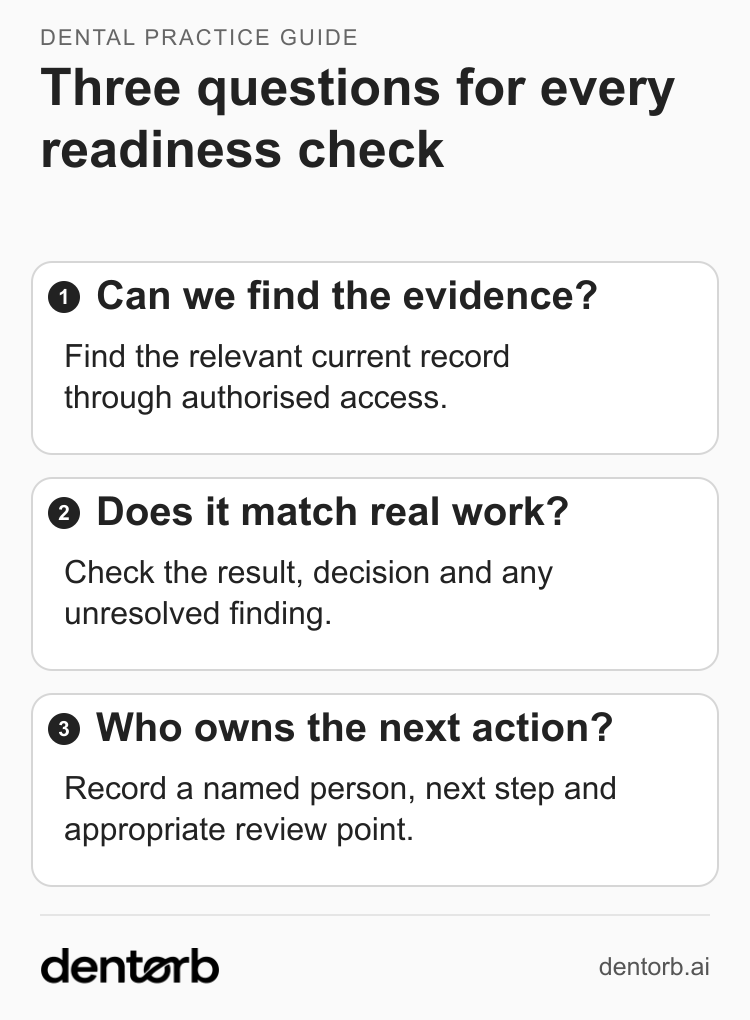
Use these three questions to turn an evidence check into a clear next action.
For each readiness check, find the relevant current record through authorised access. Check whether it matches real work, including the result, decision and any unresolved finding. Record a named person, the next step and an appropriate review point.
Staff training and professional records
Start with the person's actual role. CQC's recruitment guidance under Regulation 19 requires robust recruitment procedures, relevant checks and appropriate qualifications, competence, skills and experience. It also requires registration with the relevant professional body where that is required for the work or title.
Do not copy a single bundle of Disclosure and Barring Service (DBS), health or certificate requirements onto every role. Have the responsible lead confirm which checks apply and record the basis for that decision. A checklist helps you find and test evidence; it does not decide someone's eligibility or fitness to work.
Keep team training assurance separate from an individual's professional learning record. Continuing professional development (CPD) is learning that maintains or develops professional practice. The General Dental Council (GDC) says registrants must keep a CPD record and personal development plan (PDP), and submit an annual CPD statement. Its recording and submitting CPD guidance explains the requirements. A course booked for next month is not completed learning.
Use the mandatory training guide to think through role requirements, then the training matrix example to organise team evidence. Check what evidence the practice needs before copying a full personal learning record into a shared folder.
Keep sensitive staff information restricted. For sickness and injury records, the ICO says access should be limited to people who need it for their jobs. An evidence index can point an authorised person to a protected record without displaying its contents to the whole team.
Policies and understanding
Check which procedure is current, who owns it and when it was reviewed. Resolve confusing superseded working copies while retaining the history your record-management approach requires. Give relevant staff access to the current procedure and a way to ask questions.
An acknowledgement records receipt or a stated response; it does not establish understanding by itself. Where a change affects safety, discuss how it applies to normal work. Record appropriate learning, supervision or a practical check instead of treating a signature as the complete evidence. The policy sign-off register guide shows how to keep the version and follow-up clear.
Test one awkward record
Choose a record that could expose a weakness, rather than only the easiest completed example.
Fictional example: a servicing task is marked completed, but the attached report lists a fault. The task label cannot tell the manager whether the equipment may be used. The responsible clinical or equipment lead needs to assess the report and the safety implications, apply any necessary restriction and record the decision.
| Finding | Immediate response in this example | Owner | Evidence needed before closing |
|---|---|---|---|
| Service report lists an unresolved fault | Escalate to the responsible lead; assess use and any restriction promptly | Named clinical or equipment lead | The assessment and decision, any repair record and any required check before use |
| Follow-up evidence has not arrived | Keep the issue visible and chase the agreed action | Named follow-up owner | The missing evidence, checked by the appropriate person |
| Someone has marked the task “done” | Separate the service visit from resolution of the fault | Responsible lead | A traceable outcome rather than an unexplained tick |
This is a management example, not equipment-specific clinical advice. Follow the relevant instructions and obtain competent advice. The equipment register versus maintenance log guide explains why an inventory entry and evidence of safe maintenance serve different purposes.
Complaints, communication and governance
Follow a concern from the initial report through the response and any change made. Can an authorised colleague understand the decision without asking the original manager? Check whether the team knows how to raise a concern and find the procedure.
For meetings, record decisions, owners and review points. Our meeting guide explains why accurate minutes and meaningful acknowledgement matter more than collecting signatures alone.
For audits, keep the finding, action and outcome together. A clean template or recurring reminder is not proof that a check happened.
Review unresolved gaps without inventing a timetable
Start with safety concerns, missing evidence and overdue actions. CQC's Regulation 17 guidance says identified risks must be reduced or removed within a timescale that reflects the risk and its impact. Risks also need appropriate escalation.
Use applicable requirements, equipment instructions, professional guidance, risk assessments and local procedures to set the actual schedule. A manager's weekly review can help track progress, but it cannot replace a required daily check or justify delaying an urgent response.
At each review, ask:
- Is there a safety concern needing action now?
- Is any required check overdue or unsupported by evidence?
- Has a role, service, procedure or requirement changed?
- Who owns each open action, and what will show it is resolved?
- Can a second authorised person find the record and understand the outcome?
Keep the review point and any reason for delay visible. Do not silently move a deadline or close an item because someone has promised to send evidence.
Use software to support the evidence trail
Dentorb's practice compliance page describes scheduling checks, attaching evidence and following up exceptions. When evaluating it for your practice, ask the team to demonstrate how a failed check stays visible, who reviews it and how the history is retained.
Use that walkthrough to test your real workflow alongside your clinical practice management system. A dashboard summarises the information entered; it does not independently establish compliance or decide whether care is safe. Start with one awkward record and make sure the next person can follow its evidence, decision and next action.