


Dental policy sign-off: record the version and follow-up
Build a dental policy sign-off register that identifies the version read, unanswered questions and practical changes. Includes an on-page example.

Published by Dr Sim Raiyat
Clinical Director, Dentorb — Private General Dentist
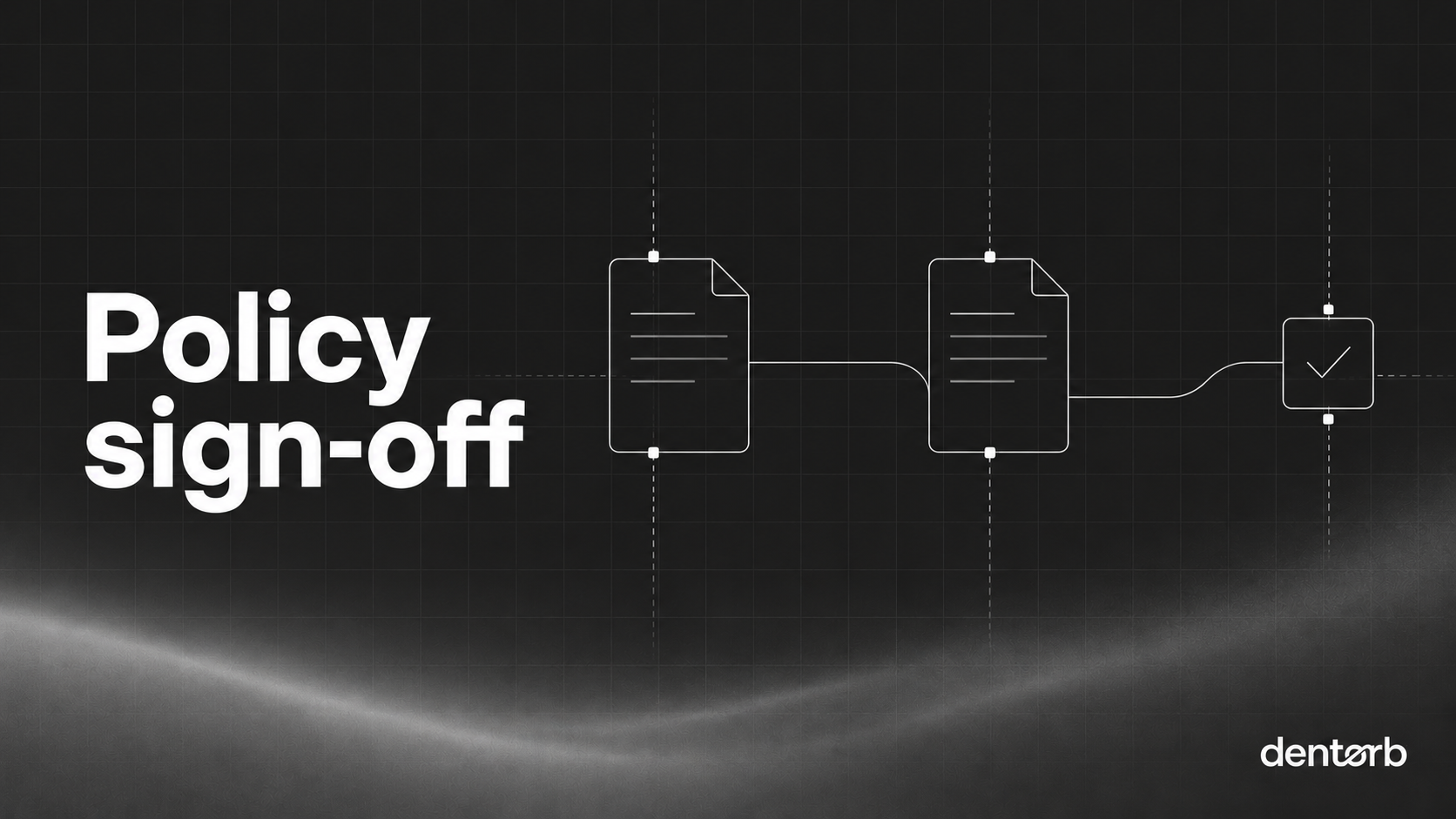
A policy sign-off register should show which version a person reviewed and what happened next. A signature or click records a response. It cannot, by itself, tell you that the person understands the instructions or follows them in practice.
Start by deciding what the policy changes in someone's work. If nobody can explain that clearly, collecting more acknowledgements will not solve the problem.
Give the policy one controlled identity
Keep a stable policy reference, version, owner and approval record. Make it clear which copy is current and how earlier versions are retained under your records policy. A familiar filename such as “final-policy-latest” is not a reliable version system.
Identify the relevant roles. Explain why people need to review the policy and give them reasonable access and support. Do not send every policy to every person simply to increase a dashboard completion rate.
What belongs in the register?
| Field | Fictional example |
|---|---|
| Policy ID and version | POL-014, reception handover, version 3 |
| Relevant people | Reception team and managers covering the desk |
| Change summary | Open enquiries now have a named handover owner |
| Review request | Date sent and appropriate response date |
| Person's response | Reviewed; question raised about weekend cover |
| Follow-up | Manager to clarify the weekend handover |
| Outcome | Clarification issued and any further review recorded |
Record the actual response date. If a person is absent or cannot access the document, keep the item open with a sensible next step. Do not enter a response on their behalf to make the report look complete.
Explain the change in ordinary language
Provide a short summary: “From Monday, enter the next action and owner before handing over an open enquiry.” Link to the current procedure and show where that action happens.
For a complicated or safety-relevant change, involve the appropriate lead in deciding what explanation, training or practical check is needed. Keep those activities connected to the policy record rather than assuming the read receipt covers them all.
CQC's well-led guidance for dental practices treats written policies as one source of evidence and considers staff knowledge. It does not require a separate written policy for every inspection prompt. This guide therefore describes a useful management method, not a universal legal requirement for electronic signatures.
Worked example: version 2 becomes version 3
Illustrative case: reception staff acknowledged version 2 in September. In October, version 3 changes who takes responsibility for unresolved weekend enquiries.
Keep September's responses attached to version 2. Issue version 3 with a clear change summary and record the relevant new responses. Do not make old signatures appear to acknowledge the later wording.
A staff member asks what happens when the named owner is absent. The manager records the question, agrees cover and updates the instructions. If the clarification changes the policy materially, decide who needs to review the resulting version again.
The question is useful evidence of an implementation problem. Treating it as non-cooperation would leave the problem hidden.
Distinguish three records
| Record | What it can establish | What it cannot establish alone |
|---|---|---|
| Acknowledgement | The recorded person gave the stated response to an identified version | That the task is always carried out correctly |
| Understanding or practical check | What was checked and the observed outcome | Every future situation or every individual's competence |
| Implementation action | The change, owner and recorded follow-up | That an unresolved risk has disappeared |
When the policy follows a meeting, link the decision rather than copying sensitive discussion into a widely shared register. The meeting-record guide explains the difference between agreeing a record and completing an action.
Check the system with a real exception
Ask an authorised colleague to find the current procedure, its change summary and an unanswered question. Then inspect a synthetic policy update: can they distinguish the previous responses from the new request?
Dentorb's practice compliance area and meeting tools describe related evidence and acknowledgement workflows. Confirm how they represent policy versions, corrections and unanswered questions before relying on the summary percentage.
Close the loop with a short practical check of the changed task. If an incoming receptionist can locate an open enquiry and identify the next owner, you have useful evidence that the handover instruction is working—not merely that a document was opened.