

How to plan bank holiday cover in a dental practice
A simple yearly routine for UK practice managers: decide how each bank holiday works, explain how it counts towards leave, and plan cover before the requests arrive.

Published by Marcus Raiyat
Founder, Dentorb
Bank holidays are easy to see coming and still catch practices out. The surgery closes, or opens with fewer people, and the weeks either side fill up with leave requests, catch-up appointments and staff who aren't sure whether the day counts against their allowance. A little planning, done once a year and checked each quarter, keeps the rota calm and the team clear on where they stand.
Start with the dates for your nation
Bank holidays differ across the UK. England and Wales have eight, Scotland has nine and Northern Ireland has ten, and some fall on different days, so a practice group with sites in more than one nation needs a list per site. GOV.UK publishes the confirmed dates a couple of years ahead (UK bank holidays on GOV.UK). Put them into the practice calendar as soon as they're confirmed, along with any extra or moved days announced for royal or national events.
Then decide, for each date, whether the practice will close, open as normal, or open with a reduced team. Write the decision down and share it with the whole team early, ideally when you publish the year's rota. People plan family time around these days, and a decision made three weeks before Christmas causes more friction than one made in the spring.
Be clear about how bank holidays count
There is no automatic legal right to have bank holidays off with pay. Employers can include them in the statutory minimum of 5.6 weeks' paid holiday or give them on top, and what applies is whatever each person's contract says (holiday entitlement on GOV.UK). Most disagreements come from people assuming one approach while their contract says another.
Check each contract and write a one-line summary the team can understand, for example "Bank holidays are included in your annual allowance" or "Bank holidays are given in addition to your allowance". Part-time staff need particular care, because bank holidays fall more often on some weekdays than others. Someone who never works Mondays would lose out if they only benefited from bank holidays that land on their working days, so their entitlement should be worked out pro rata. ACAS explains the principle in plain language (bank holidays and part-time workers on ACAS), and it's worth asking your HR adviser or payroll provider to confirm the method you use.
Plan cover before the requests arrive
The weeks around Easter, the late spring and summer bank holidays and Christmas are the busiest for leave. If you wait for requests to come in, you end up approving on a first come, first served basis and discovering the gaps afterwards.
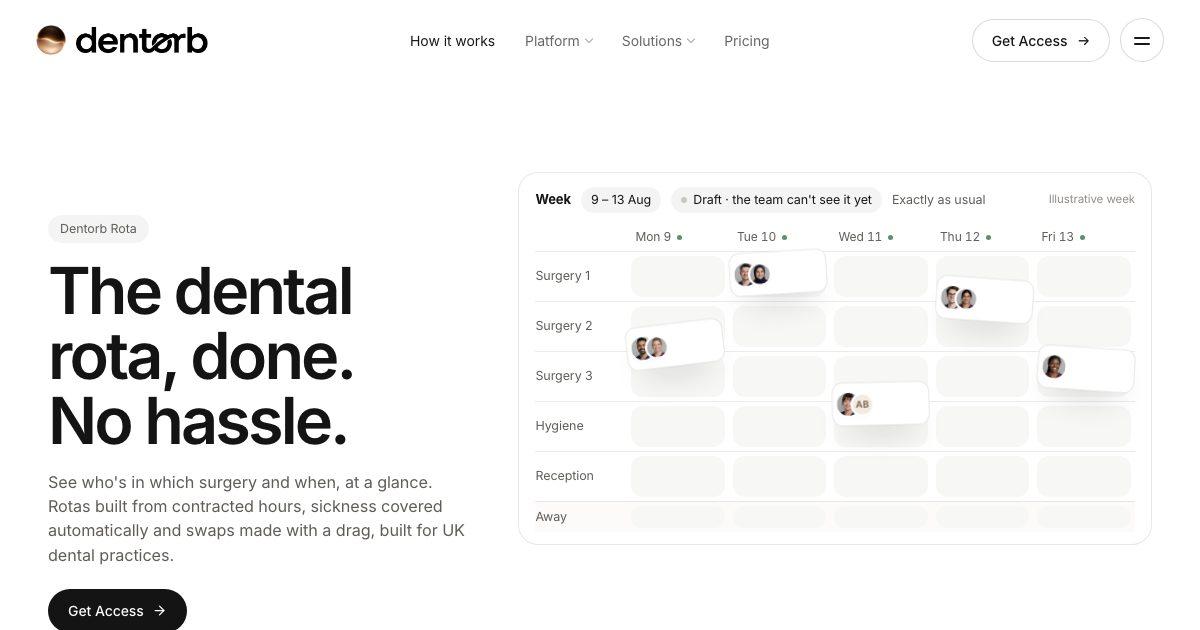
Instead, work out the minimum cover each day needs first: which surgeries must be open, how many dentists, nurses, hygienists and reception staff that takes, and who can cover which role. Then open leave requests for those weeks with the minimum cover visible, so people can see where there's room. If you use rota and leave in Dentorb, requests and cover sit on the same screen, so a manager can see the effect of approving a request before saying yes.
Our guide to setting up rota and leave rules covers how to turn these decisions into rules the whole team can follow, and the surgery cover rota template is a good starting point if you plan on paper or in a spreadsheet first.
Share out the less popular days fairly
Some bank holidays are more popular than others, and the days either side of Christmas and New Year are the most sought after of all. Keep a simple record of who worked or took which days last year and use it to share them out in turn. When the rota is seen to be fair, people are more willing to swap when something unexpected comes up.
If the practice opens on a bank holiday, be clear in advance about what working it means. Some practices give a day off in lieu, some pay a premium and some treat it as a normal working day. Any of these can be reasonable, as long as it matches the contract and is applied the same way to everyone.
Look after patients and the diary
A closure needs the same care as any other change to opening hours. Update your website, phone message and online booking at least a few weeks ahead, and make sure patients with urgent problems know where to go, whether that's your own out-of-hours arrangement or NHS 111. Look at the diary for the days before and after: recalls and routine appointments can often be moved to quieter weeks, leaving room for the urgent appointments that tend to build up over a long weekend.
A short checklist
- Add the year's bank holidays for each site's nation to the practice calendar.
- Decide for each date whether to close, open as normal or open with a reduced team, and tell everyone early.
- Check each contract and write a one-line summary of how bank holidays count.
- Work out part-time entitlements pro rata and confirm the method with your adviser.
- Set minimum cover for the busy weeks before opening leave requests.
- Keep a record of who worked which days, and share the less popular ones in turn.
- Update your website, phone message and online booking well before each closure.
Planning bank holidays this way takes an afternoon once a year and saves a lot of last-minute rota changes. If you'd like your rota, leave and cover in one place, you can apply for access to Dentorb.
Frequently asked questions
Do staff have a legal right to bank holidays off?
No. Bank holidays can be included in the statutory 5.6 weeks of paid holiday or given on top; what applies is set by each person's contract (GOV.UK).
How should part-time staff get bank holidays?
Work out their entitlement pro rata, so people who don't usually work Mondays aren't left with less holiday than colleagues. Confirm the method with your HR adviser or payroll provider.